Sunday, April 20, 2008

FIRE in your workshop…the damaged UK Nat.M/cycle Museum Velos.

Grahame Rhodes sifts for Velocette parts in a devastated Museum hall.

I guess we all have our heads in the sand when it comes to the possibility of damage, to the extent of total damage , to the motorcycles we cherish and keep in our workshops.


Ex. Eric Oliver Mk.8 KTT


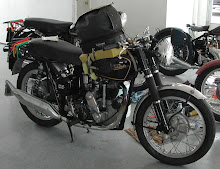
The 1961 24 Hr. Venom record Breaker

As a reminder and it really is a stark reminder, as many will not have seen these photographs before, taken by Ivan Rhodes, when he answered the call to attend to the fire ravaged National Motor Cycle Museum near Coventry, UK in October 2003.

These are the examples of the Velocettes that were destroyed, some to date have latterly risen from the ashes, but the fact remains that they really are only a replica of the destroyed bike.
The pictures tell the story… factory Velocette racers and the 24 hr. record breaking Venom….
Ex. Stanley Woods, Australian Tour 500cc SOHC, e/no. MT5002


500cc SOHC MT5002


The resurrected Record Breaker...


Left click on the photos to enlarge.


Get smoke detectors and fire extinguishers in your workshop/garage and protect your bikes!

Friday, April 18, 2008

The ROTACETTE


Little is known of this unusual machine, other than snippets of information from over the years.
It was believed to have been made in the tool-room at Kirby Engineering in Sydney, NSW, during the early 1940s.
It is based on a Velocette Mk.2 KSS engine ( e/no. KSS5351 ).
Kirby was known later for the manufacture of small engines, in fact they were called upon to supply replacement engines for the disasterous LE Velocette Industrial engine supplied to the NSW creamed ice-cream maker "Mr Whippy"....but more of this in a planned future blog item on this engine.
I remember it languishing outside Ryan and Honey’s, a bike wrecker at 4 Hunt Street, Sydney, likely around 1964.
In fact I was interested to buy it and the then proprietor, Laurie Mitchell, a likeable rogue, suggested £49/10/- ( Australia changed to decimal currency $ and cents in February 1966)…a fortune to me at the time.
It’s condition was about the same as it looks now, complete with flat front tyre. The bike has had a hard life, judging by the red rusty primary chain and general condition.

One item missing is the petrol tank, which I’m sure had a Velocette style transfer “Rotacette”…The bike is currently owned by the racing Roberts family in Sydney, who to date have been unable to get it to start.

A rotary valve head on a KSS bottom half….the pictures will tell the story…

The article basically as is I published in FTDU331, Autumn 2005.
Left click on photo to enlarge.

Thursday, April 17, 2008

VELOCETTE postage stamps...

Postage stamps have been issued by numerous countries depicting motorcycles and of course the Isle of Man would be the best known to sporting motorcyclists.
Australia had never done this and so when the Centenary of Velocette approached in 2005, the rally committee organising the National rally, which was to be the Centenary rally with the target of 100 Velocettes in attendance ( we actually got over 135 on the appointed photo shoot day…) we investigated something special.
Clubmember Stuart Browne did the hard yards and we came up with the stamp depicted. They are rare and I still have some left and affix them to letters to overseas Velo people where possible….
Illustrated are two first day cover I got while in the IOM at the TT in1974 and 1975.
As well the special Velocette stamp, franked by Australia Post is also illustrated
Ok, I couldn't resist slipping a picture of the Centenary Velocette photo shoot in...it goes further on the right, not included in this picture.
Left click on photo to enlarge.

Tuesday, April 15, 2008

TWO VELOCETTE’S IN ANTARCTICA…..

I guess it would be impossible today… taking any motorcycle to Antarctic, let alone an older, likely oil leaking one….
But…. It has been done, not once but twice with Velocettes in 1961 and 1968 ( I haven’t done definitive research on this, so there may be others who have taken a motorcycle down there, although initial use of Google has found a woman Benko Pulko who took a motorcycle in 1997 on a round world odyssey and another round world adventurer, David McGonigal who also got his motorcycle to Antactica …) The two Velos were taken by Australians Bill Kellas and later Frank Scaysbrook,
Frank Scaysbrook, his MAC, an Adelie penguin and a husky,Mawson base 1968.
who were taking up a years posting at the Australian base at Mawson, Wilkes Land, Antarctica.
In January 1961, the Danish Polar vessel, "Thala Dan" sailed from Appleton Dock in Melbourne bound for Mawson Base in the Australian Antarctic Territory, carrying 30 expeditioners, plus round trippers and supplies for more than a year.
Deck cargo included a R.A.A.F Dakota (DC3) A65‑81 stripped of wings and propellers, sitting on a special cradle on the main hatch cover. In the hold below was a 350 cc MAC Velocette that had the previous year, been ridden from Perth to Melbourne by George Cresswell.
“Thala Dan" moored in Horse Shoe Harbour at Mawson on 25 January after an uneventful voyage. Unloading the 800 tons of cargo was completed by 9 February after which we were able to relax and take the Velocette for a run around the camp in perfect summer weather. Riding there was difficult over the rock‑strewn ridges around the Harbour and the permanent ice slope behind Mawson was fairly steep and slippery.
In late March the sea began to freeze over and within a few weeks the ice depth was 10 inches or more, strong enough to take the weight of vehicles. The coast either side of Mawson as far as one could see, was ice cliffs ranging from 50 to 500 feet along with glaciers, ice caves, and snow drifts overhanging the cliff tops, carved by the wind to every possible shape.
In preference to Dog teams or heavy vehicles, the Velocette was used for coastal tours, often towing skiers or a dog sled. It was totally reliable and easy to start even in extremely cold conditions. The only modifications were dry lube on the control cables, lighter oils, a warmer spark plug and a briquette bag tied across the crash bars to protect our boots (Mukiuks) which were not water proof, from slush thrown up by the front wheel. Only a spare spark plug and a few basic tools were carried and on occasion, extra fuel.
One other advantage of the Velocette was its relatively light weight and low centre of gravity, when picking it up after a long slide on its side after suddenly encountering bare polished ice at high speed. The Velocette was dropped many times and never sustained any damage and none of the riders were injured. Top speed was 80 ‑ 85 mph indicated, but would have been less due to wheel spin.
The sea ice was the greatest surface Kellas claimed to have ever ridden over. It is strongest when first frozen and even relatively thin ice supported by water, is incredibly strong if of uniform thickness. As the year progresses the ice becomes thicker in depth, but with the return of the sun in Spring it begins to soften and rot from below. While the surface still looks secure, underneath it is like a soft sponge.
Bill Kellas's MAC
The Velocette was used, weather permitting, until the middle of June by which time riding was uncomfortable in the low temperatures when wind chill made frost bite a daily occurrence.
Clothing was mainly ex‑Army Korean War issue and not designed for bike riding and didn't include helmets. The Velocette was parked covered in the open until the Sun reappeared.
In spring with the daylight and temperature increasing, riding resumed as before but caution was required as the sea ice began to soften.
In early December the worst blizzard of the year struck with wind speeds exceeding the range of the anemometers (which were destroyed or failed) and visibility reduced to a few feet in drifting snow and ice crystals. This blizzard continued unabated for two days and on the third day was still gusting over 100 knots.
The Dakota and the Beaver aircraft were at the airfield at Rumdoodle in the Masson Range when the blizzard struck. When the wind and drift subsided sufficiently to venture out doors, it was found that the Beaver (which was behind a wind fence) was totally destroyed and the Dakota had broken its tie‑downs and had disappeared without a trace.
A few days later when the weather had cleared, Graham Currie riding the Velocette on the sea ice West of Mawson noticed something red high up on the glacier top.
Bill Kellas at speed on the MAC
Closer inspection confirmed it was the Day Glow red tail of the Dakota.
The plane had been blown by the blizzard about 15 miles down slope at sufficient speed, with brakes engaged, to wear the tyres and wheel rims flush with the skis. It came to rest after the undercarriage dropped into a crevassed area on the cliff top about 400 feet above the sea ice. It had then turned nose to wind and was wrecked.
Because of the crevassing around the wreck site, it was unapproachable for salvage, except caution by foot. The recovered gear, the Doppler radar, radio's, Survey Cameras along with some aircraft parts were lowered down the cliffs to the sea ice, now very soft and dangerous, to a dog team and the Velocette towing a dog sled.
The salvage was completed in two days and on the final run, a 3’ standing wave of rotten ice was visible chasing the fleeing Velocette and sled.
The total mileage covered during the year was about 3000 miles. Individual trips up and down the coast ranged from local to 50 (+) miles. The Velocette was ridden hard to cover the distances quickly, parked while areas were explored and photographed, restarted and ridden home without ever a problem. It was simply taken for granted that it would always get us home again and our faith in the bike was never misplaced.
At the completion of our tour the Velocette passed into the hands of our relief party. Beyond that point I have no knowledge of its history.
Frank Scaysbrook went in the 1968 expedition to Mawson for 14 months in the Weather Bureau and also had a 350 swinging arm MAC, which he dismantled in Australia and crated for the sea voyage to the base, re-assembling it in March.
The Australian Antarctic base, Mawson, late 1990s.
When the Velo was ready to go, the exit from the workshops doorway to the outside world had to be dug through 10 feet of snow…winter was on its way…
The Velo was parked outside at all times, yet it’s starting habits were impeccable…running on 80/87 octane aviation gasoline and Long life oil, three or four swings on the kick start were enough to get the engine firing.
The MAC was returned to Australia and is still in Sydney with Frank’s brother Dick.
Article and photos courtesy of Doug Farr, Bill Kellas, "MotorCycling" , edited by me and published in part in FTDU #331, Autumn 2005 edition.
Left click on photo to enlarge.

Saturday, April 12, 2008

From Viceroy Scooter to small Hovercraft


The 1964 Viceroy engine with cyl.head fins milled to a "pent-house" shape to reduce resonance.


The Velocette Viceroy scooter had a brief production run from 1960-64 during which time less than 700 were made. Sadly it epitomised what a motorcyclist felt a scooter should be, rather than what the market thought and as such was not popular with buyers and eventually withdrawn from the market. In fact the design and tooling was financed by a loan in 1959 of £75,000 of which some £45,000 was still outstanding when Veloce Ltd went into voluntary liquidation in 1971.
Additionally Veloce sold 38 engines for the Viceroy to DMW motorcycles for a scooter they were marketing and were approached by Hover-Air Ltd., of Peterborough UK, who had found that the engine had a good power to weight ratio and would be ideal for both lift and propulsion for their Hoverhawk hovercraft.
They used three engines, one for lift and the other two for propulsion. The Hoverhawk had a maximum speed of 25mph over water and 35mph over land.
By September 1967, Veloce had supplied 165 Viceroy engines for this hovercraft.


left.....Hoverhawk HA5
Sixty seven of the Mk1 and Mk2 Hawks were believed built using the Viceroy engines but from then on they were fitted with Sachs Wankel engines [Mk3].

Production started in 1967 and ended in 1971.
Nothing appears to be known about the Hoverlark other than it possibly used only one Viceroy engine..
Additionally several engines were supplied for use in powered gliders.
The information for this came from Drew Duncan and Alan Dean both members of the Aust. VOC who contributed material to me for inclusion in FTDU320 of June 2002 and FTDU322 of Dec.2002. I also re-read the thesis and quoted in part from it; “A History of Veloce Limited, Motor Cycle Manufacturers, Hall Green, Birmingham”, submitted by Joseph W.E. Kelly, MSc, C.Eng. in fulfilment of the requirements for the degree of Doctor of Philosophy at the University of Bradford, UK, March 1979.The section in Dave Masters book, "Velocette, An Illustrated Profile of Models 1905-1971" was also read .
Left click on photos to enlarge.

Friday, April 11, 2008

Me and my Banjos......

I’m a late starter into music, having only been playing some 14 years.
However I now play regularly each week in a 7 piece traditional/dixieland jazz band and in trios and duos and consider myself a working musician, having retired from active speedometer work.
My VEGAVOX 4 banjo, a 1956 model.
Venus de banjo......
I recall one day working on a speedometer ,I thought, I need to do something for me, something special for me. I need to play music… I’d always liked the banjo so that seemed the way to go…wrong! A dying instrument, they are not easy to find in Sydney and then I needed to find somebody to teach me how to play it. Little did I know then that there were three types of banjo….the 5 string, favoured by bluegrass and country players, the tenor, a 4 string with 19 frets and favoured by jazz bands and Irish bands and the 4 string , 22 fret plectrum or standard banjo, also played in jazz bands but great for solo chord melody work. Judy came back with an instruction book from the city, still no banjo ( the book was for a 5 string and I still didn’t realise it at that stage)..then as always opportunities arise…speaking with a chap I did speedometer work for who also used to play guitar in trios etc, he responded that his father played banjo and now dead he had the banjo and I could buy it.
It was a 22 fret KAY brand plectrum banjo.
Fruitless searches in the yellow pages telephone directory and calls to music shops all proved blank for a music teacher.
“Think out of the square, DQ…” I looked for Jazz clubs in the white pages, found the Jazz Action Society and The Sydney Jazz Club, they recalled a chap in St.Ives, Sydney, Paul Baker who played and possibly taught banjo.
Indeed he did and what’s more he played the same style banjo I had.
This would prove to be a boon, for he is likely the only teacher of banjo in Sydney, certainly at that time and proved to be outstanding in the US style of banjo playing as I found out in time.
I had lessons for over 10 years with Paul and we are firm friends and we dep. for each other in music jobs that clash with bookings we have.
Playing in the 7 piece Bridge City Jazz band in Sydney.
So what banjos do I have…?
My favourite banjo is made by the USA company Vega, who went out of business in early 1970s after trading for nearly a century. They operated out of 155 Columbus Ave., Boston Mass. USA.
As well as Banjos, they marketed other brass and reed instruments under their name, although they were made for them by others ( likely Conn in La Crosse, Wi., for the brass instruments such as trumpets, tubas etc).
They made several styles of banjo and the one I favour is the Vegavox, the Vox model from Vega. Designed for them in about 1926 by the banjo great Eddie Peabody ( the first entertainer to sign a contract for $1,000,000 in 1926….) and it continued basically unaltered until 1970, in several guises, the Vegavox 1, 2,3,4 and Ultra. The latter being flashy with gold plating and gems around the instrument.
Eddie Peabody featured with a new 1928-29 Ford and playing a VEGAVOX banjo.
The have a great sound. I have a Vegavox 1, 4 and Ultra and enjoy playing all of them. They are carefully set up to feel and play the same.
I have two other banjos… funny banjos with me are like motorcycles, or Velocettes in particular…I have 6 Velos at present & have had up to 10 at once…
Yes, I'm a "Street Person", a "busker"...busking in a Sydney suburb with some other geriatric musos ( Wally Temple, bent soprano sax, left and Peter Johnson,clarinet, right). I'm playing one of my D'Oole banjos...it certainly "keeps us off the streets".....
These other banjos are made by Pat D’Oole in Geelong, Victoria.. that’s right an Australian banjo. They also have the resonator similar to the Vegavox, a deep resonator rather than the normal banjo. They also were made with shorter scaled necks for both Paul Baker and myself…the length of the neck is 1½” shorter , but still with the 22 frets. Playing the banjo you use your left hand to fret the chord formation on the neck ( well 99% of banjos are played right handed and the occasional one is left handed)…the shorter scale means you don’t have to stretch your fingers to form difficult chord shapes, as you would on the Vegavox and you can move faster around the neck during playing.
Talk about an eccentric…….
Left click on photos to enlarge.

Thursday, April 10, 2008

Winston Churchill...Velocette Enthusiast?


Yes if you believe this, then Winston Churchill was a Velocette enthusiast........
Left click on photo to enlarge.

The "VELOCETTE" knitting pattern.

You don't have to be a Velocette enthusiast to appreciate the scripted "Velocette" logo... Many people stop me on the street and ask how they can get the pattern, well no excuse now, all you need is a compliant friend, wife, who-ever and of course who can knit......


Modelling the finished product is popular US and Aust.VOC clubmember, Californian Mick Felder.

VELOCETTE KNITTING PATTERN
Row

1 81b 2m 17b b= black
2
2m 13b 6m 79b m=mustard
3 77b 13m 5b 4m 1b
4 2b 23m 75b
5 72b 25m 3b
6 6b 25m 69b
7 65b 24m 11b
8 16b 23m 61b
9 57b 22m 21b
10 5m 21b 21m 53b
11 49b 20m 24b 5m 2b
12 3b 5m 2b 6m 20b 19m 45b
13 41b 18m 19b 2m 2b 3m 6b 1m 1b 2m 5b
14 6b 2m 1b 2m 6b 2m 1b 4m 5b 2m 15b 17m 37b
15 33b 16m 18b 5m 3b 7m 6b 1m 2b 2m 7b
16 8b 2m 2b 1m 6b 3m 2b 3m 1b 6m 2b 4m 16b 15m 29b
17 25b 14m 20b 5m 1b 9m 4b 3m 5b 1m 2b 2m 9b
18 9b 2m 3b 1m 5b 4m 3b 5m 2b 8m 5b 4m 15b 12m 22b
19 19b 10m 12b 2m 4b 7m 3b 2m 3b 3m 3b 4m 2b 2m 1b 2m 5b 1m 3b 2m 10b
20 10b 3m 3b 1m 4b 2m 3b 1m 2b 3m 4b 3m 3b 2m 2b 8m 2b 5m 15b 8m 16b
21 13b 6m 13b 2m 4b 6m 1b 2m 3b 3m 2b 2m 4b 3m 3b 3m 2b 1m 3b 2m 4b 1m 3b 3m 11b
22 1b 4m 7b 3m 3b,1m 3b 3m 2b 2m 1b 3m 4b 2m 3b 4m 1b 3m 5b 8m 3b 4m 3b 3m 10b 4m 10b
23 7b 4m 6b 1m 4b 5m 1b 6m 1b 2m 4b 3m 3b 1m 2b 8m 2b 2m 4b 3m 2b 2m 1b 2m •4b 2m 3b 3m 5b 7m
24 2m 2b 4m 5b 3m 3b 2m 4b 3m 4b 3m 3b 3m 3b 2m 2b 2m 2b 3m 2b 4m 3b 6m 2b 7m 2b 4m 7b 4m 4b
25 3b 2m 8b 6m 1b 2m •1b 4m 3b 4m 3b 2m 1b 2m 2b 2m 1b 1m 1b 2m 3b 1m 3b 2m 4b 4m 11b 1m 3b 4m 5b 2m 5b 1m
26 1m 6b 2m 4b 4m 3b 2m 11b 4m 4b 5m 3b 2m 4b 2m 1b 2m 3b 1m 3b 3m 4b 3m 3b 9m 7b 2m 2b
27 1b 2m 6b 3m 4b 3m 4b 2m 4b 3m 3b 2m 2b 2m 2b 2m 3b 2m 5b 2m 5b 1m 1b 3m 10b 2m 3b 4m 5b 2m 5b 2m
28 1b 2m 2b 1m 1b 3m 4b 4m 3b 2m 11b 2m 2b 1m 12b 6m 2b 3m 2b 2m 2b 3m 4b 3m 3b 4m 4b 4m 4b 2m 1b
29 3m 3b 3m 4b 5m 4b 2m 4b 3m 3b 1m 2b 3m 4b 2m 14b 1m 2b 2m 11b 2m 3b 5m 4b 4m 2b 2m 2b
30 3b 2m 3b 2m 3b 6m 4b.2m 10b 3m 2b 1m 20b 5m 4b 3m 3b 3m 4b 2m 2b 2m 4b 7m
31 1b 3m 5b 2m 3b 3m 4b 2m 4b 5m 3b 3m 20b 1m 3b 2m 10b 2m4b 8m 5b 3m 4b
32 6b 15m 4b 2m 9b 3m 3b 1m 28b 9m 4b 2m 4b 2m 8b
33 8b 2m 2b 3m 2b 5m 4b 3m 27b 34 2m 2b 4m 8b
34 2m 5b 13m 8b 10b 12m 5b 2m 9b 3m 1b 2m 28b 3m 3b 3m 6b 5m 8b
35 9b 3m 6b 3m 3b 3m 29b 5m 8b 3m 5b 4m 3b 3m 13b
36 14b 1m 5b 1m 1b 2m 5b 3m 8b 3m 30b 3m 3b 3m 18b
37 17b 3m 3b 4m 23b 1m 15b 3m 31b
38 32b 5m 11b 3m 29b 4m 16b
39 41b .2m 4b 8m 4b 7m 34b
40 37b 20m 43b
41 46b 14m 40b
42 44b 6m 50b

This was written and published by me in the Australian Velocette Owners Club magazine, "FishTail DownUnder", #339, Autumn edition.
Left click on photos to enlarge.


Wednesday, April 2, 2008

OVERLAND TO EUROPE BY MOTORCYCLE IN 1974

Reading travel stories and in particular articles in older motorcycle magazines of the overland trip from or to Europe whetted my interest and as I finally approached completion of my long running part time tertiary education course, plans were made with my close friend Jim Day to ride to Europe. I did the paperwork and together we built large luggage panniers for our bikes and I imported a 32 litre petrol tank from Germany for my 1971 BMW 500cc R50/5 motorcycle.
At the end of January we took the motorcycles to QANTAS and arranged to airfreight them to Singapore ( it was then, the cheapest method).
Judy and I together with Jim and Val, flew to Singapore a day or so later and collected the bikes, took in some sightseeing then set off across the land bridge for Malaysia to ride up to the island of Penang where transhipment to India occurred.
Many people are unaware that you cannot travel across Burma by motor vehicle The borders closed during WW2 and this remains the case even today. My BMW being craned aboard the MV "Chidambaram" at Penang.
Most overland trips start from Europe and doing it that way, you are introduced to the poverty, begging etc gradually. Doing it in reverse as we did meant you we introduced to the daily life of Asia suddenly and it can be a shock. Prior to this trip we had only toured NZ by Velocette in 1968...that may make an interesting story..? The sea trip was 4 days across the Bay of Bengal to the port of Madras in S.India. Customs when we arrived was a new experiance...in hindsight "greasing palms" with money was what was required to expedite matters, but we were green and did it the hard way. Two days later saw us travelling south to the very tip of India at Cape Comeran, where several oceans meet and where the sun rises from the sea to the east and sets into the sea to the west...Originally plans were to tranship to Ceylon/Sri Lanka and tour there, but storms had washed away the facilities for loading on the indian side for an indeterminate time, so we re headed north. 1974 was the first of the major oil shortages world wide and India was hard hit. Often petrol stations had no fuel for weeks. Both bikes had large fuel tanks fitted and the range on my BMW, travelling at 80kph was around around 800km a tankfull so we largely avoided this problem.Judy at a petrol stop, surrounded by the enevitable crowd when we stopped. The south of India, especially Kerala State was different to the area of Madras, largely Roman Catholic to the more common Hindu it featured many waterways with small villages.
Travelling north we ended in New Delhi, were we had to wait for several weeks as an Islamic conference in Pakistan meant the borders were closed. We met up with an NZ couple in a Kombi van and so left the BMW in the campground and travelled to Agra, Jaipur and back doing a tourist bit.
Above shows a time we became "lost" due to indifferent directions.
Judy in the Red fort at Agra with the Taj Mahal in the background.
Travelling through Pakistan, we came to the Khyber pass, the infamous passage from Pakistan into Afghanistan, which is closed during the night...naturally the hill tribespeople ignore this. There is a charge to enter the pass and traverse it...


The Khyber gorge. Arriving in Kabul we spent a week there and travelled by mini bus with some other overlanders to the most northern city in Afghanistan, Mazar-i-Sharif, near the Russian border to view a special National celebration day.
This involved travelling over the Salanger Pass, some 12,000' high.Judy in Kabul with the usually armed locals....


The Hindu Kush mountains on route to Mazar-i-Sharif.
Mazar-iSharif at dusk
Mazar-i-Sharif was an experiance. It was claimed over a million people were there. Rooms for the night proved impossible to get. We finally slept on the flat roof of a hotel under the stars for several nights. The pic is taken from our "bedroom".
The trip across Afgahnistan to the Iranian border proved uneventful, although negotiating the borders was a different matter. You needed to arrive at a border crossing in the morning as it invariably took 5 or more hours and most borders closed around 4pm. There was often a "no mans land" between the two countries of up to a kilometre and it frequently happened that you exited a country only to find the other border closed and unable to return spent the night between countries.
Iran, still under the rule of the Shah also proved uneventful, athough late snows forced us back to Tehran for an extra week to await suitable weather. Camped at Gol-e-Sahra camp ground in Tehran.
Centre of Tehran.
Reaching the Turkish-Iranian border near Dogubayzit we just got through before the border closed for the night, but in doing so an error occured with the Carnet-de-Passage et Duoane, effectively the passport for your vehicle. Issued by the motoring oranisation in your country on behalf of the countries requiring it..then India,Pakistan,Afghanistan,Iran,Turkey, it had a monatary bond attached to it, released when the vehicle was finally "exported"...this meant for us Turkey. A page had been removed by accident and months later the carnet was considered to be active, despite our being in Germany. For once a Customs dept., rather an official, in Munich assisted with the necessary paperwork to "prove" the BMW was in Germany & reason prevailed- we got our bond back.
The weather turned sour in East Turkey, quite high and near Mt. Ararat, reputed site of the biblical Noah's Ark final resting place. Approaching a one lane bridge in light snow, disaster struck....we were forced off the road by an overtaking bus.
We end over ended, crashing... I was knocked out and Judy took charge, erecting the fly of our tent to aford some cover from the snow.
Briefly stopping, the bus sped off, leaving us to our own devices.
Phew...both front fork legs bent, the wiring loom around the ignition switch burnt out...
Some hours were spent jury-rigging the bike and we rode on slowly to Erzurum where enquiries for truck or rail transport for us and the bike to Istanbul proved fruiltess. The idea of riding the damaged bike over several snowed in passes, up to 12,000' high seemed not an option.
Finally a local gas station owner, speaking English arranged for his brother, who didn't speak English to transport us in his car. Money changed hands... then the car arrived..a small Fiat 124, with an equally small boot/trunk. Phew! Out came the front forks and wheel and the BMW squeezed in. Our panniers and Judy squeezed into the back seats and we were off... three days continuous driving finally saw us into Istanbul at the BP MotorCamp.
Enquiries with Turkish customs over importing the parts for the bike revealed a 200% import tarriff plus an additional sales tax. Making our way back to the motorcamp we came across a British registered semi-trailer. Eventually we arranged for the bike and ourselves to be transported to Munich. We slept in the spare bed in the truck cabin and our bike was strapped under the trailer to the from jacking legs. Seven days later and we were in Munich and at Krauser's, a BMW shop I'd purchased parts from over the years, I repaired the bike and we finally arrived into London.
Vienna-Salzburg autobahn.....
Back in Munich at Krauser's in 1975 with friend Brian Anderson.
Left click on photos to enlarge.