Tuesday, June 17, 2008

Pictures from my Archive… a frequent dip into photographs that I want to share with you….

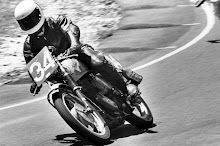
Brooklands, the oval banked circuit that is near Weybridge in Surrey, England has been in the news recently for motorcyclists, with the 100th anniversary of the first motorcycle race there and all the "nobs" turned out many with historic racers that were used there.


Well I've several photographs to show you, one is the repairs to the banking during the winter of 1935, another of the late Chas. Mortimer Senior who had just collided with a barrel used as a marker, also during September 1935. I've also two of Les Archer, snr, attempting a 100 mile record...check out the sidecar...these were called "coffins"... can't imagine the passenger staring at the rapidly vanishing road surface for an hour....4th May 1932, they averaged 79.52mph.
Dai Gibberson also kindly sent me several of it's construction in around 1905....
Photo credits to Fox Photos, London, "The Motor Cycle", London and wherever Dai


sourced his from.....


Left click on photos to enlarge.


Sunday, June 15, 2008

Honda Production Racers in the early 1960s....

I’m on a bit of a roll with the research in some of my files over these earlier Honda racers and find the Super Sports versions fascinating…
For 1962 Honda introduced a series of production racers mirroring technology gained from their Grands Prix racers.
These were intended to provide suitable machines for good riders and obviously to continue the advertising success Honda were enjoying.

These 50cc items I covered in an earlier blog, but form part of this production racer series...
In the 50cc class for selected sale to the racing public they offered the CR110 Cub racer, which was an air cooled single cyl.4 stroke engine, DOHC with gear train drive, 49.99cc with 40.4mm bore x 39.0mm stroke, 8.5bhp at 13,500rpm, 0.46kg torque at 11,500rpm, magneto ignition, 8 speed gearbox.

As well Honda produced a sports model of the CR110 for the road Same engine details, but 7bhp at 12,700rpm, 5 speed gearbox, max. speed 100kph (62mph), 2.25-18 tyres front and rear, 75kg dry machine weight with a price then of 170,000 yen.


In the 125cc class came the CR93Benly racer, a twin cylinder gear driven DOHC 4 valve per cylinder engine, 124.8cc capacity bore and stroke 43.0 x 43.0mm; 21.5PS at 13,500rpm with 1.05kg torque at 10,700rpm, twin carbs, magneto ignition, wet sump, 10.2:1 comp.ratio. 5 speed gearbox, tyres 2.50-18 front and 2.75-18 rear, drum brakes with 2LS front and SLS rear.
Likely for Japan only was offered a Super Sports or Clubman version of the CR93 racer, called the CR93 Benly racer Super Sports., same engine detail, with 16.5PS at 11,500rpm and 1.05kg torque at 10,700rpm, 5 speed gearbox, max. speed listed at over 135kph(84mph), dry weight 127.5kg, wheels and tyres as per the production racer. Price then 300,000Yen.


For the 250cc class, came the CR72 racer, a twin cylinder gear driven DOHC 4 valve per cylinder engine,247cc bore and stroke 54.0 x 54.0mm, twin carbs.,wet sump, 6 speed gearbox,29PS at 9/500rpm and 2.06kg torque at 7,500rpm 150kg dry weight, tyres 2.75-18 front and 3.00-18 rear, drum brakes front and rear with 2LS front and SLS rear.
There does not appear to be a directly related Super Sports road version.
The 350cc class had an enlarged type of CR72 engine, capacity 305.4cc, bore and stroke 60 x 54mm, 29PS at 9,250rpm .I have little other detail and leave it up to you to compare the photographs.
Then as mentioned before, Honda retired from formal Grand Prix racing around 1968 and it all became history…..
Data and photographs for this blog are acknowledged from “Honda Collection 1”, Honda Collection 2” (published by Honda Motor Co.,Ltd, Honda Collection Hall Museum Project and printed in 1994 by Neko Publishing Co.,Ltd, Japan) and Million Mook “Exciting Bike” the Honda Story, published in Japan 1991. All are in Japanese.
Left click on photos to enlarge

Saturday, June 14, 2008

Time for another banjo photograph...

Frankly when I set up this blog and mentioned banjos, I didn't really think there would be much content of interest to those, likely , predominantly motorcycle interested people looking at my blog, but what the heck, I have to endure the interminable banjo jokes, so I'm getting my own back, but this will be the only banjo item for a while..... and the banjo cartoon, yes Larry Larson of "Farside" fame plays banjo....
Picture is taken at the 56th Australian Jazz Convention in December 2001 and held in Adelaide, South Australia and shows John Packham from NSW , standing and playing a Bacon and Day tenor banjo, while seated beside me and playing a Vegavox 1 tenor banjo is Lance McGuire from Queensland and of course me playing my Vegavox Ultra plectrum banjo. Judging by the serious concentration we were reading a music score we were not that familiar with.

Left click on photo to enlarge.

Friday, June 13, 2008

Pictures from my Archive… a frequent dip into photographs that I want to share with you….


Following my overland trip to Europe in 1974, I often called into Michael Krauser's business in Germering, a suburb of München, then West Germany.
He was the biggest BMW dealer in the area, a former sidecar racer himself and a sponser of GP sidecar racers using BMW Rennsport engines. His workshop was well equiped with an engine dyno and the photo shows a Rennsport engine under test. I've forgotten whose it was.
As well he had on loan the 1939 500cc supercharged Rennsport racer that resided in the BMW museum. This was considered to be the 1939 IOM Senior TT winning machine, ridden by Shorsh Meier, but MLG Motorcycles in London also had one they considered was "the machine" and even had the riding number of Meier , #49, fitted to it...the München version had #1.....interesting...
John Surtees now has the MLG one and he is as adamant as to it's history.
Unsure what BMW's current position is....
Anyhow, it was late April 1974, Krauser was preparing the BMW version of the prewar Renssport for Meier to parade at the forthcoming Vintage races at Salzburgring in Austria. He was going to take it the next day to the BMW test facility, "would I care to come"...would I....
Next day dawned....you guessed it light snow was falling and thus the test was off! We adjourned to his rolling road dynomometer where I had to be content to see it rip the rear C7 Racing Metzeler tyre to shreds on the rollers...must have some torque....
Quite an experience...
Pictured is the engine and the complete machine.
Photos were taken by me.
Left click on the photos to enlarge.

Wednesday, June 11, 2008

Honda 50cc Racers…RC112,RC113, RC114 & RC115

Between 1962 and 1965 Honda made four different 50cc twin cylinder Grand Prix racing motorcycles.
Money seemed no object and all had differing engine castings and configurations….
All were air cooled 4 stroke twins with gear driven overhead camshafts.
The RC112 of 1962 was a 2 valve DOHC engine, 49.61cc, bore 33.0mm x stroke 29.0mm, listing over 10bhp at 17,500rpm, 0.45kg of torque at 15,000rpm, magneto ignition, wet sump, 9 speed gearbox, 62.5kg machine weight, drum brakes SLS front and rear, tyre sizes 2.00-18 front and 2.25-18 rear, max. speed over 140kph(87mph).
The RC113 of 1963 changed to a 4 valve DOHC engine, 49.61cc, bore 33.0mm x 29.0mm stroke, listing over 10bhp at 19,000rpm, transistor ignition, 2 carbs,( piston valve), wet sump, 9 speed gearbox, 53kg machine weight, front brake a push bike calliper type, rear 2LS drum, 2.00-18 front and 2.25-18 rear tyres, max. speed over 140kph (87mph).
I have no specification listing for the 1964 machine, but it was the RC114, a twin cyl. 4 valve DOHC engine..


The RC115 of 1965 again was a 4 valve DOHC engine, 49.75cc bore 34.00mm x 27.4mm, listed as over 13 bhp at 20,000rpm, transistor ignition, 2 carbs ( piston valve), wet sump, 9 speed gearbox, 50kg machine weight, front brake a push bike calliper type, rear 2LS drum, 2.00-18 front and 2.25-18 rear tyres, max. speed 154kph (96mph).
Interestingly the machine weight fell from 62.5kg to 50kg over 4 years development with the max. engine rpm rising from 17,500rpm to 20,000rpm & engine power from 10bhp to 13bhp.
I recall there was a rumour at the time, never substantiated, that Honda had a 4 cylinder 50cc engine under development,,, amazing!
Looking at the pictures the crankshaft fits into a human hand!! The gear wheels in the 9 speed gearbox must have been really thin, almost like a slitting milling machine cutter.
For 1962 Honda produced a production racer in 50cc format for selected sale to the racing public. Called the CR110 Cub racer, it was an air cooled single cyl.4 stroke engine, DOHC with gear train drive, 49.99cc with 40.4mm bore x 39.0mm stroke, 8.5bhp at 13,500rpm, 0.46kg torque at 11,500rpm, magneto ignition, 8 speed gearbox.
As well Honda produced a sports model of the CR110 for the road! Same engine details, but 7bhp at 12,700rpm, 5 speed gearbox, max. speed 100kph (62mph), 2.25-18 tyres front and rear, 75kg dry machine weight with a price then of 170,000 yen.
Then Honda retired from formal Grand Prix racing around 1968 and it all became history…..
Data and photographs for this blog are acknowledged from “Honda Collection 1”, Honda Collection 2” (published by Honda Motor Co.,Ltd, Honda Collection Hall Museum Project and printed in 1994 by Neko Publishing Co.,Ltd, Japan) and “Motorrad Classic” 5/2000 Sept./Oct., published by Motor Presse-Verlag, Stuttgart, Germany.
Left click on photos to enlarge.

Monday, June 9, 2008

Pictures from my Archive… a frequent dip in to photographs that I want to share with you….

What a job..... talk about green with envy..."The MotorCycle" editor, although it could be George Wilson who was a journalist with them at the time, tests Freddy Frith's 1949 Junior TT winning 350 DOHC works Velocette following the race. The photo was taken up on the mountain road in the IOM where these tests occured....
Left click on the photo to enlarge.
Many of these photos come from sources that still hold the copyright. For example Morton’s Motorcycle Media, publishers of “Old Bike Mart”, “Classic Racer”, “The Classic Motor Cycle” now own many old EMAP publications such as “The MotorCycle” and “MotorCycling”. They are happy for me to publish with due acknowledgement and where not for commercial gain.
Other photographs come from Fox Photos , Keystone Press Agencies and S.R.Keig Ltd.

Saturday, June 7, 2008

An introduction to KTT Services...my business for 25 years.

This is a short introduction to my business, KTT Services, which specialised in the repair and restoration of motorcycle and to some extent car instrumentation, usually from the past....

This isn't starting anywhere in particular, chronologically, but I've a few of the interesting instruments I built for customers to share with you. In many instances I have had aluminium bodies cast and machined or metal spun, bezel rims spun ( I have over 50 different rim varieties and shapes that I have manufactured and still supply the instrument trade worldwide) , dial faces screen printed and here I do the printing myself from a stock of over 700 different dial types.

Now this dial printing has spawned many "specials" and two illustrate this blog.... the large coloured one was for a customer who walked into my shop...

Talking of my shop, I've included a picture taken by a Japanese customer and judging by my beard colour it was over 10 years ago.....

This customer had a Harley Davidson he had customised with polished aluminium and paint everywhere..he was really into Ned Kelly ( don't know who Ned Kelly was? "Google" the name...an Australian bushranger ..read outlaw..in the 1800's) and wanted the dial face to be him...Ned Kelly used a tin helmet that covered his head, just like in the dial and the pointer of the speedo was covered with a brass etching of a rifle...hmmm.
The other , a set of instruments for a Velocette in Germany, for Velo enthusiast Gert Boll, was for his Metisse Velo special...see the photos... Sadly it caught fire and burnt badly.
Not to be outdone, Gert rebuilt it and I remade new instruments for him....
The Velocette with the speedometer dial was the logo I adopted for my business... it , to me, epitomised what I did... rode Velocette's and fixed speedos.


Left click to enlarge photos.

Friday, June 6, 2008

Pictures from my Archive… a frequent dip in to photographs that I want to share with you….

It is my good fortune to have a well stocked library of motorcycling ( and occasional other) photographs and literature and as the current “custodian” I want to ensure they are made available to as many people as possible…so I’m indulging myself on a frequent basis with a pic or two from it….. Look on!….


What to start with.....?
In an earlier blog I described how in Jan.1974 we set out from Sydney to ride overland to Europe to fullfill what had been an ambition of mine, having read many stories of others who had made the same trip in both directions.
In London, another desire was to ride to the English Dragon Rally, held during the winter in Wales and to ride to Germany to the Elephant Rally. Held in mid winter in the Eiffel mountains I'd read reports of it many times. So in Feb.1975, I set out alone ( Judy "Piked out", so I took her sleeping bag as well as my own...), with Jim and Val Day on their R60 BMW, taking the cross channel ferry from Dover to Oostende in Belgium and then by road to the Nurburgring in the Eiffel mountains...boy was it cold riding... -10°C... but woops, I'll save the story for a future blog.
The picture shows us camped at the Nurburgring, bikes beside...my R50/5 BMW has now acquired an Avonaire fairing and the snow shows the weather....
Left click on the photo to enlarge.

Thursday, June 5, 2008

Anatomy of a Never-was....

Compact and trim, immensely appealing in its simplicity of layout and construction, the forlorn little overhead-camshaft 250 cc engine looks as though it might have the makings of a real winner and no doubt when the first pencil strokes of its design were committed to paper, it seemed more promising still.
Veloce Ltd., the makers concerned were well-respected for their ohv three-fifties and five-hundreds, but there was a definite need for a sporty two-fifty in the range. Why, they might have even consider re-entering the racing field with it; in a modest sort of way.
Bertie Goodman recalled: “Some time in 1960 – we had a policy meeting at which my uncle Eugene (managing director at that time) and I, as sales director, discussed several ideas for future models.”
“One thought was for a new design of five-hundred, but I felt that we should go for a unit-construction two-fifty, and that was the type on which we settled.”
There has been 250 cc Velocettes before, notably the GTP two-stroke with throttle-controlled pump lubrication, and the push-rod MOV model from which the Viper and Venom had descended.
But the newcomer was a complete break with Hall Green tradition in that it was to have a single overhead camshaft driven by chain.
“We had in mind an engine to power a reasonably-priced touring bike,” continued Bertie, “yet capable of being developed at moderate cost into a useful racing unit.
To keep the selling price down, the bike would have the Viper front fork and wheel, and as many other standard components as could be used.”
“Charles Udall was our chief designer – this was just before he left us, to join AMC in Woolwich – and the drawing-office work was done under his direction by George Wilkes.”
“At first, we hoped to cut costs by making use of the then-new Royal Enfield five-speed gear cluster. But Enfield refused to play ball so, instead, we talked with the Ariel company – and with Burman, who made the Ariel assembly – for permission to get supplies of the internals of the Ariel Leader gear box.”
“They agreed, and if you study the engine as it now stands, you will see that the gear-box shell – though the machining of it was never finished – was intended to accept the Ariel bits.
“I forget the actual dimensions we decided on, but it would almost be certainly have been square – 68 x 68mm bore and stroke rings a bell somewhere. There should have been a standard British Hub rear wheel.”
The dualseat, mud-guards and electrics were to be brought-out items, so we would not have had to produce many parts of the bike in our own works.
As for the projected road-racing programme, you have to remember that around this time a machine such as the OHC NSU single was still competitive.
The Japanese onslaught was a bit in the future, and we would have stood quite a reasonable chance with an engine turning out 30 bhp or thereabouts.
For racing we would have had to use a higher compression piston, and a bigger inlet valve and inlet tract, so we purposely left extra metal in the cylinder head, to be bored out as necessary with race development in mind.”
With design work completed, Charles Udall said a (temporary) farewell to Hall Green. Now began the job of translating the drawings into metal – and the Goodman’s were having second thoughts about some of the Udall ideas.
“ For one thing,” says Bertie, “the overhead-cam-shaft chain was to run through two nylon tubes, but that would have meant a chain with a connecting link; and, anyway, the use of plastic in such a location was untried.
“We changed that to the light-alloy case you see on the engine as it stands.
“ Another feature was an oil tank integral with the crankcase castings, and located between the case and gear box. That wasn’t new, of course – Royal Enfield used it with success, and we had used it ourselves as far back as 1914 – but we were a little worried about the oil getting too hot.
“ Instead we decided to have an external tank, but we didn’t alter the relationship of the crankshaft and gear-box mainshaft centres, and that accounts for the size of the crankcase assembly.
“ The prototype was put in hand, but we never did get around to making a camshaft for it. That was to have been my job, and the calculations were all-but finished, Somewhere at home, I have a notebook with the figuring for the cam profiles.
“The crankshaft was done, and it would have taken very little more time to complete the engine. Forgotten...?
“ Why didn’t we? I honestly can’t remember. So far as I can recall, there was no commercial reason, but somehow or other the pressure eased and the whole project grew cool.
“ The engine, in so far as it had been assembled, was pushed under a workbench and forgotten.”
That workbench is no more. A brand-new, Lucas factory has arisen on the site of Velocette’s old Hall Green works. Yet, incredibly, the engine-that-never-was has survived.
Present owner is Matt Holder of Aerco Tool & Jig Company, holders of the names for Velocette, Scott & at one stage Vincent.
Holder made great efforts to keep the Velocette name by making new patterns and dies to replace lost or damaged Hall Green originals, and by building up stock of new engine and gear-box spares and the firm continues today under the direction of his son.
It caught his eye at the auction of Velocette assets, and he knew he had to have it.
Perhaps one day they may well complete the job, and it would be great to see how it performed.
This is part of an extract from a article that appeared in the British motorcycle weeklies some 20 years ago, copyright is now held by Morton’s Motorcycle Media in UK.

You know the engine looks in some ways like the Honda CB100/125 of the early 1970s....
Left click on photos to enlarge.

Monday, June 2, 2008

Army Velocettes...

WW2 Army Velocettes
The second World War seems to be the first time Velocette's were seen in the military and the WD Velocette was the MDD, with Velocette given an order for 1200 military MAC’s from the French Government. However only a few were delivered before the French capitulation to the advancing German Army and the rest of the order was taken up by the British War Dept. with the official title MAC (WD). They became known as the MDD. Engine and frame numbers started at MDD1101 produced in June 1940 through to MDD12201.
100 ex French machines went to the Regional Ordnance Depot, York, UK and the rest to the Army Chilwell, Central Ordnance Depot.
Supposedly another 200 unnumbered engines were ordered, but completion is not clear.
Price was £51.
Phil Irving improved the WD (MAC) spec. during 1941 and when the UK War Office placed another order for 2000 WD (MAC’s) in June 1941 it was changed in favour of the MAF.
MAF..the “AF” meant Army forces.
Only 947 MAF’s were eventually built with matching frame and engine numbers starting with MAF1001.
Probably not delivered till late 1941 and ending with MAF1748 in Sept.1942.
Because the MAF was comparatively expensive the order was cancelled with most going to the UK, although some were said to have gone to Russia.
The photo of the WW2 MAF together with the closeup of the timing area shows the replacement timing cover and gearbox cover in cast iron rather than the usual aluminium. The aircraft industry at war had first call on aluminium.
The price was UK£68.


During 1940 road motorcycles in UK were required to have blackout masks over their headlights and taillights with a slit illumination only. The photo of the 1940 production MSS Velo shows this.The photo of the rows of machines with Velocettes visible to the LHS is in April 1946, when the Army was selling off all their now surplus motorcycles, including those impressed during the war. The other photo of the "aviated" KSS Velo is captioned "Training army motorcyclists..." Left click on photos to enlarge.
Australian Army Velocettes
Interesting tale of a 1960 MSS Velocette, Engine number MSS12883 which was delivered from the Velocette factory to the Australian Army for proving trials as an Army successor to the WW2 WLA Harley Davidson in use up to then by the Aust. Army dispatch riders and which now has 2777 miles on the clock.
It wasn’t successful in the trials, as the Army adopted the BSA B44 ( an unmitigated disaster, as I rode them in my time in the Army Reserve…..)
Following an advert in the “Melbourne Age” in 1964, Aust. Velo OC member and stalwart Leo Andrews went to the Army auctions at Tottenham, Victoria and successfully bid about £200 for the bike. Leo’s friend Lyle Clark brought the other Army MSS auctioned on the day, a bike he painted black and eventually sold. Leo still has his although it has never been civilian registered or ridden on the road. The photo shows Leo with friend Bruce Phillips ( hand on seat).


Acknowledgement is given to Dave Masters from whose interesting book "Velocette, an Illustrated Profile of Models 1905-1971" I quoted from on the WW2 Velos.